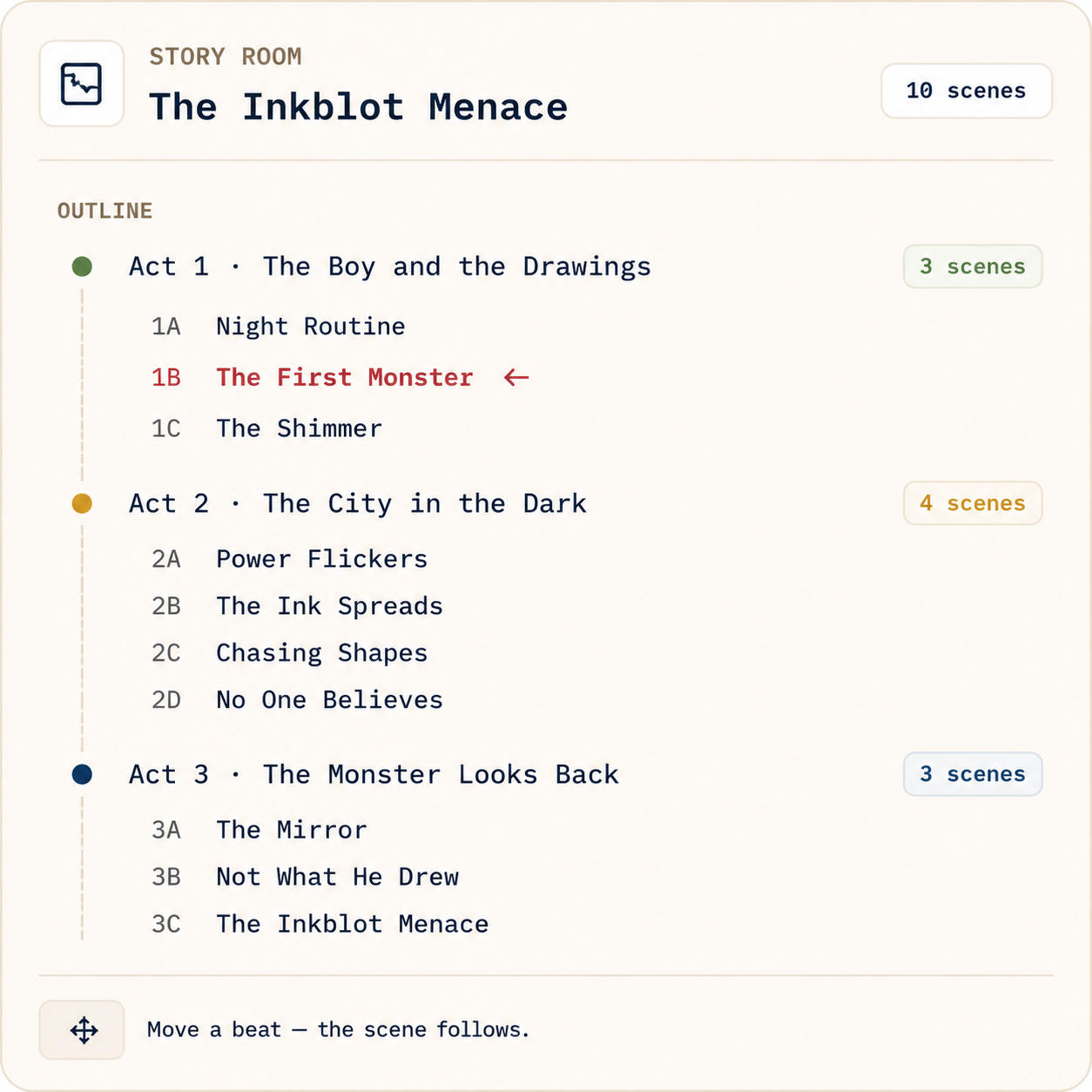
Start on the page
Grow a premise into an outline, then real pages in production format. Branch for rewrites; the script stays the source.
Not a folder of clips — a film. Script, cast, locations, board, takes and cut live in one project graph held by one scene memory, so a change anywhere ripples everywhere it should and the picture still holds.
Five stages, each carried by a module you can open right now.
Grow a premise into an outline, then real pages in production format. Branch for rewrites; the script stays the source.
Lock each character's identity — face, build, gait — and manage wardrobe per scene. The same person in scene 1 and scene 47.
Construct your locations as navigable 3D worlds. Dress the set, place the light, block the scene with a virtual camera before generating anything.
The board syncs from the script; every shot arrives knowing its scene, cast and world. Generate takes with that context attached.
Takes return as versioned assets on their shots. Assemble the cut, swap takes, deliver the film.
Continuity isn't a retouch pass here — it's how the project is built.
Scene headings wire the script to worlds, light and cast — INT. BRICK HOUSE — NIGHT means the same thing everywhere it appears.
Cast and locations are locked assets, not lucky prompts. The same face, the same room, scene after scene.
Change the script and the change ripples to the affected shots; the rest of the film holds.
Summon the agent crew — screenwriter, producer, canvas operator — reading live project state, acting only with the autonomy you grant.
Start with a premise, a screenplay, or a folder of references. We'll set up your provider keys and walk through the first scene with you.
Cookie settings
We use analytics cookies to improve MML ONE. You can decline anytime. Privacy